

By using our website, you agree to the use of cookies as described in our Cookie Policy
Can Container Restaurants Keep Up With a Busy Crowd?
Most restaurateurs think shipping containers are just about affordability and aesthetics. Trendy design, lower overhead. But the operational reality is different — and if you don't plan for volume, you're setting yourself up for chaos. Containers may look sleek on Instagram, but they come with hard limits on capacity, workflow, and service speed. Especially when the lunch rush hits or a weekend event packs your patio.
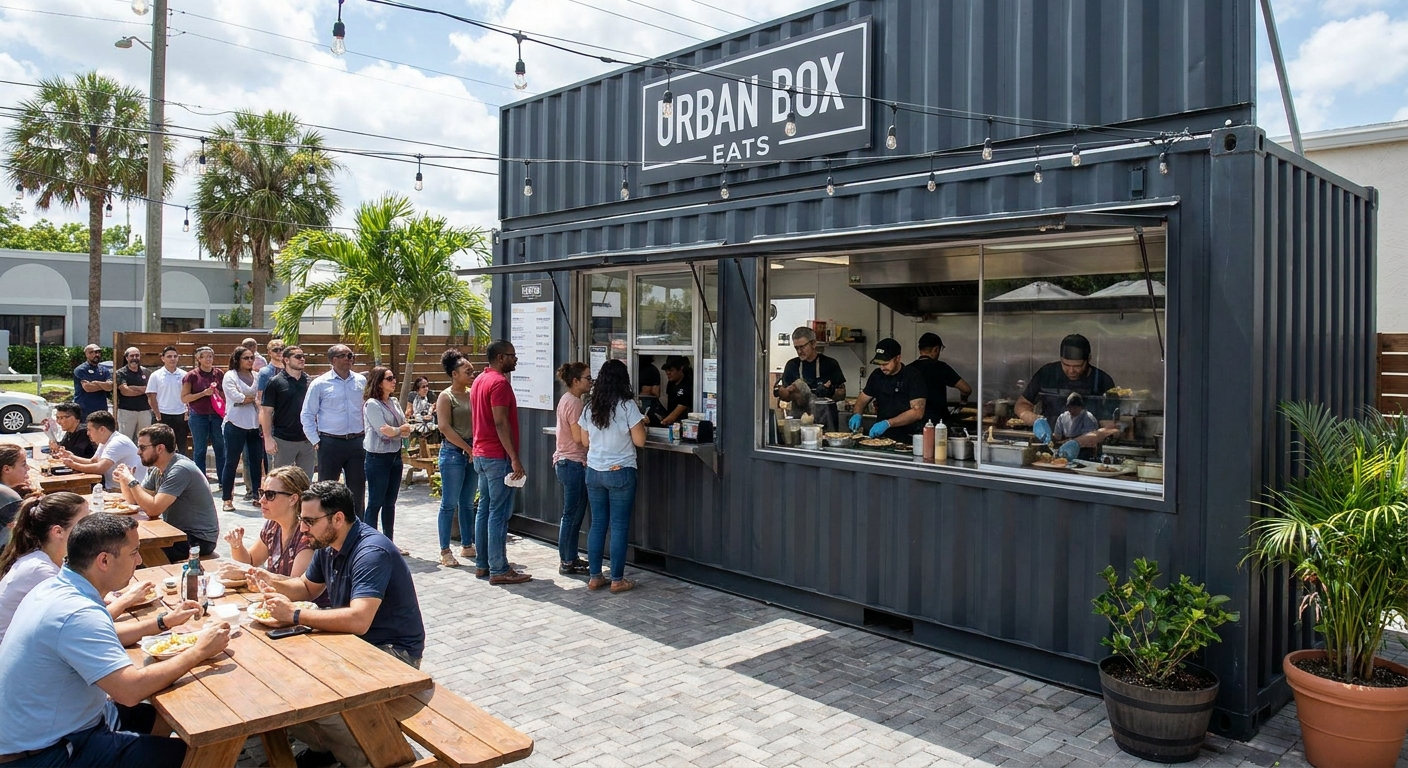
Here's what matters. If you're building a container food concept to serve real volume, that's smart. Just don't assume the novelty alone will carry you through peak hours. Every seat should be part of a capacity plan. Every inch of kitchen space needs purpose. And every service decision should be rooted in how fast you can turn tables — not just how cool the space photographs.
Square Footage Doesn't Lie
Containers are small. A twenty-footer gives you maybe 160 square feet. A forty? Double that, but still tight once you add kitchen equipment, storage, and a few tables. You can stack them, link them, or open one side to the elements — but at the end of the day, you're working within fixed dimensions. And when fifty people show up at once, those dimensions become very real.
We've seen operators try to stretch capacity by adding outdoor seating or creating communal dining zones. That works in good weather and cooperative zoning. But it doesn't solve the core issue — your kitchen is still in a box, and your staff still has to navigate a narrow corridor during service. If you can't seat them fast or feed them faster, the line grows and the experience suffers.
The Kitchen Has No Room for Error
You can't fake efficiency in eight feet of width. Every piece of equipment has to earn its spot. Every cook needs a clear lane. And every dish on your menu should be designed for speed and repeatability, because there's no space for complicated plating or multi-step prep during a dinner rush.
Smart operators simplify. They cut the menu down to six or eight items that move fast and hold up under volume. They invest in high-output equipment — combi ovens, induction burners, rapid cook tech. And they build workflows that let one or two people handle the load without tripping over each other. If your setup requires three bodies in the kitchen, you've already outgrown the container kitchen model.
Staffing Gets Tricky Fast
Labor in a container restaurant isn't just about headcount — it's about spatial choreography. You need people who can pivot between roles, who don't need elbow room to function, and who understand that efficiency beats effort when space is the constraint. A great server in a traditional dining room might struggle in a ten-foot aisle with twenty impatient customers waiting outside.
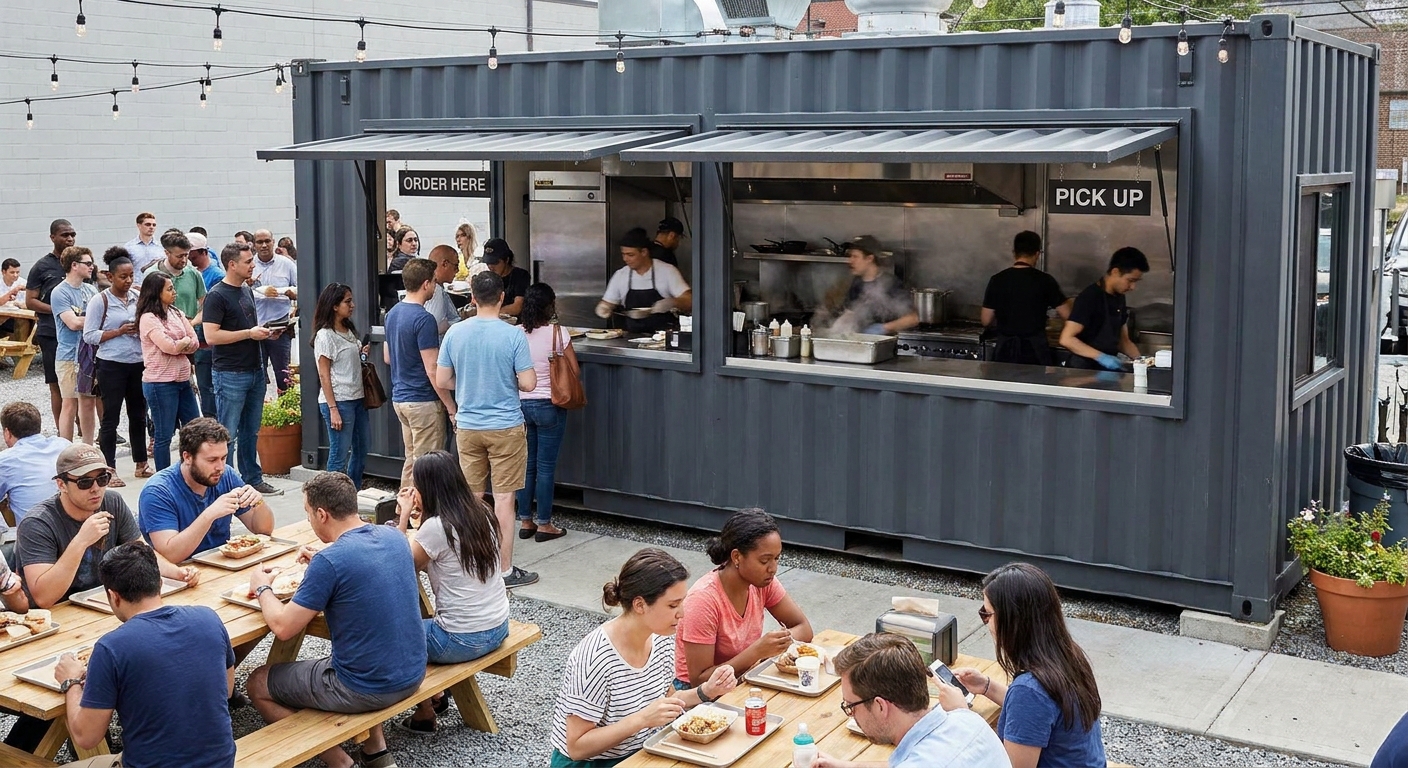
Some concepts solve this by going counter-service or app-based ordering. Customers place orders on their phones, pick up at a window, and seat themselves. That cuts down on front-of-house complexity and keeps the focus on speed. It also shifts expectations — people know they're not getting white-glove service, and they're fine with it as long as the food comes out hot and fast.
Scaling Means Rethinking the Model
Containers are modular, which sounds like an advantage. And it is — until you realize that adding another container doesn't just double your capacity. It doubles your utilities, your permitting headaches, and your coordination challenges. You're no longer running one kitchen; you're running two. And unless they're connected seamlessly, you're splitting your team and slowing everything down.
The better play for high-volume situations is often clustering. Drop your container into a food hall or a shared park where seating is communal and the crowd is distributed across multiple vendors. You handle your throughput, someone else handles theirs, and the customer experience stays fluid. It's less about your individual capacity and more about the ecosystem you're part of.
- Multi-container layouts can expand seating but complicate kitchen coordination
- Outdoor seating works seasonally but depends on weather and permits
- Shared food parks spread demand across vendors and reduce individual pressure
- Modular designs allow relocation but don't always solve peak-hour bottlenecks
- Pop-up configurations let you test volume before committing to permanent expansion
Tech Can Buy You Time
We're not talking about gimmicks. We're talking about systems that reduce friction and keep orders moving. QR code menus, mobile payment, kitchen display screens — these aren't luxuries in a container setup. They're necessities. The less time your staff spends taking orders, running cards, or clarifying tickets, the more time they have to actually cook and serve.
Order-ahead apps are another lever. If half your crowd places orders before they arrive, you can stagger prep and avoid the slammed window where everyone shows up at once. It also gives you data — you know what's selling, when, and to whom. That lets you staff appropriately and prep smarter, instead of guessing and hoping.
- QR-based ordering cuts down on order-taking time and reduces staff load
- Kitchen display systems keep tickets organized and eliminate paper chaos
- Mobile payment speeds up checkout and reduces cash handling errors
- Order-ahead platforms let you manage demand before customers even arrive
- POS integrations give you real-time data on sales and capacity trends
Customer Tolerance Has a Limit
People will forgive a lot for a good concept. They'll wait in line, sit on a bench, eat off a tray. But they won't forgive slow service or inconsistent food, especially if they've been standing in the sun for twenty minutes. The novelty of eating out of a shipping container wears off fast when the experience feels disorganized.
The key is setting expectations and then beating them. If your signage says ten-minute wait, make it eight. If your menu promises fresh and fast, deliver both. And if your space only seats fifteen, don't pretend you can handle fifty without a plan. Transparency and execution go a long way — overpromising in a constrained format just burns trust.
- Clear wait-time communication prevents frustration and manages expectations
- Consistent food quality matters more than speed in repeat customer decisions
- Visible kitchen operations can build trust and add to the experience
- Seating limits should be communicated upfront, not discovered after ordering
- Fast recovery from mistakes keeps customers happy even during busy periods
Menu Design Is Your Safety Valve
The fastest way to drown in a container kitchen is trying to do too much. A twelve-item menu with customizations and sides sounds great on paper. In practice, it's a nightmare when you're cooking in sixty square feet with one fryer and a flattop. The smart move is to build a menu that thrives under pressure — limited options, high quality, fast execution.
Think about what travels well, what holds without degrading, and what can be prepped in advance. Grain bowls, tacos, sandwiches, rice plates — these formats work because they're modular and forgiving. You can batch components, assemble to order, and keep the line moving. And when volume spikes, you're not scrambling to plate a dozen different dishes. You're just building the same five things faster.
- Limited menus reduce prep complexity and speed up service during rushes
- Modular dishes allow for batch prep and quick assembly under pressure
- Items that hold well prevent waste and maintain quality during slow periods
- Customization options should be minimal to avoid kitchen confusion
- High-margin core items let you focus on speed without sacrificing profitability
Volume Testing Before You Launch
You don't know if your container can handle a crowd until you throw a crowd at it. Soft openings, friends-and-family nights, invite-only events — these aren't just marketing plays. They're stress tests. They show you where your bottlenecks are, which menu items slow you down, and how your team performs under pressure. And they let you fix problems before paying customers experience them.
Run your worst-case scenario. Sixty orders in thirty minutes. Half the customers want modifications. Your POS goes down. One cook calls out. If your system survives that, you're ready. If it doesn't, you know exactly what to fix.
- Soft openings reveal operational weak points before full launch
- Simulated rush scenarios test kitchen capacity and staff coordination
- Feedback from early guests helps refine service flow and menu timing
- Stress tests identify equipment failures before they happen during service
- Incremental rollout lets you scale operations without overwhelming your team
Volume Success Is Built, Not Assumed
Containers don't fail because they're small. They fail because operators treat them like traditional restaurants and then wonder why service collapses under pressure. The format works — but only if you design for its constraints and optimize for throughput. Simplify the menu. Invest in tech. Train your team for tight quarters. And test your capacity before you promise the world.
We've watched large-scale container concepts thrive in high-traffic areas because they knew their limits and built systems around them. The ones that struggle are the ones that assume charm and aesthetics will compensate for poor planning. They won't. If you want to serve a crowd, build for it from day one — or accept that your business model is cozy, not scalable. For those exploring restaurant container conversions or considering shipping container brewery concepts, understanding throughput from the start makes all the difference. Even container bar setups face the same pressure — plan the workflow, or the rush will break you.
Ready to Build a Container Restaurant That Handles the Rush?
We know what it takes to turn a shipping container into a high-performing, crowd-ready restaurant. Let’s work together to design a space that’s as efficient as it is eye-catching—so you can serve every customer, even when the line is out the door. Give us a call at 805-252-2701 or request a quote and let’s make your container concept a success from day one.
‹ Back
Recent Posts
-
Can Container Restaurants Keep Up With a Busy Crowd?
November 11, 2026
-
Why Shipping Container Coffee Shops Are Easy to Expand
October 28, 2026
-
Which Businesses Are a Good Fit for Shipping Container Buildings?
October 14, 2026
-
Is a Shipping Container Retail Store Right for Seasonal Sales?
September 30, 2026
-
Can a Shipping Container Kitchen Help Your Business Grow?
September 16, 2026